Manufacturer's Analysis of Scissor Lift Structure
1. Base of a scissor lift (manufacturer's perspective)
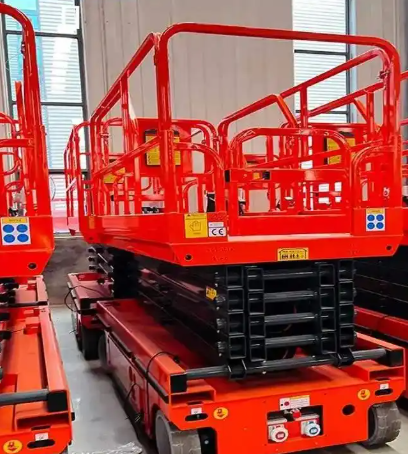
Generally, the base of every scissor lift has a welded structural chassis that distributes the load from the uprights through the outriggers. The five lower outriggers make the platform more stable. When using cantilevers, the outriggers can be extended as far as possible, which further improves the stability of the lift.
2. Mast/uprights of a scissor lift
The mast uprights are triangular lattice structures welded from galvanized square steel, racks, and rebar. The standard section height is 1.5m, and vertical sections are connected with M20×80 high-strength bolts to achieve the required height. The uprights are divided into standard sections and limit sections; the limit sections are mainly used at the bottom and top.
3. Load‑bearing beam of a scissor lift
The load‑bearing beam forms the basis of the construction lift work platform. It is a triangular lattice frame welded from three pieces of galvanized square steel. Available in two standard lengths – 1.5m and 1.0m – which can be connected with pins to achieve different overall lengths.
4. Drive unit (motorized carriage)
The drive unit is the power system of the scissor lift. It moves vertically along the uprights by means of two electric motors. Each motor has a self‑braking device that locks the drive unit onto the upright when power is cut off. The motors move along the racks on the uprights via gear mechanisms.
5. Safety and protective components of a scissor lift
Safety and protective components mainly include access gates, guardrails, mast protective covers, scaffold boards, platform stairs, etc. The access gate is the entrance to the platform and is typically mounted on the drive unit.
Recommended News
-
Which is more suitable, a manual stacker or a semi-electric stacker?
05/Jun -
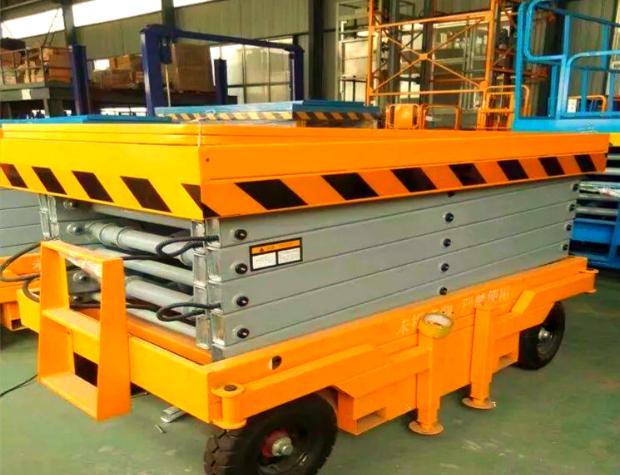
Manufacturer's Analysis of Scissor Lift Structure
05/Jun -
Drum handler: What is a drum handler?
05/Jun -
Improper use of a manual stacker can be very dangerous.
05/Jun -
Maintenance Considerations for Fully Automatic Scissor Lifts
05/Jun